BVC by SIXIS · free guide and tool

Revenue and
expense budget.

A business can look good on paper. Until you start doing the math.

Sales, expenses, investments, profit and cash. See how they connect before you make decisions.

Build your budget ↗App available in Romanian

In short

One revenue and expense budget (BVC) is a plan written in numbers: how much you estimate you'll collect, how much you estimate you'll spend, and what's left at the end, in profit and money, month by month. BVC by SIXIS is the free app where you build it. SIXIS is the company that created it.

01 · What it is

A plan in numbers, with assumptions you can test.

An income and expenditure budget answers three questions that every entrepreneur asks himself, usually too late: how much will I collect, how much will I spend and how much is left. Don't tell the future. Say what needs to happen for your plan to work.

What is the use

Use to make decisions based on numbers, not guts. Know if you can afford an extra employee, higher rent or a promotion before you pay them. A BVC for a company is basically the simulation of your year, done while you can still change things.

Estimated and realized

The budget is what you believe that it will happen. Accomplishment is what happened. The value comes in the difference between them: if you planned sales of 60,000 RON in January and made 52,000, the missing 8,000 RON is more instructive than both figures taken separately.

Profit is not cash

Profit tells how much you earned on paper. Cash tells how much you have in your account. They can be very different. Simplified example, without VAT and taxes: you sell goods worth 100,000 RON in March, but the customer pays in May. You pay the suppliers, 70,000 RON, since March.

Profit and cash, same example · hypothetical values, in RON
IndicatorMarchAprilMay
Profit on paper+30.00000
Money in account (variation)−70.0000+100.000

March looks good in relation and bad in account. A firm can be profitable and still run out of money for current payments. That's why a good budget aims for both.

02 · Why

Build your budget before you need it.

The moments when a budget makes a difference have something in common: the money is spent before it comes back.

  • You launch a business

    Find out how much you need to sell monthly to cover costs and how long the start-up money will last before you sign a lease.

  • Expand a company

    A second point of work not only doubles sales, but also costs. The budget shows in which month it pays itself, if it does.

  • You open a department

    People pay themselves from the first month, the results appear later. See the time difference, not just the amount.

  • You launch a project

    A project has a beginning, an end and a cost. The budget helps you see if it's worth it, not just how much it cost after it's finished.

  • You make an investment

    An investment moves money now and returns it in time. Payment affects cash immediately and depreciation affects the bottom line gradually.

  • Verify the sustainability of an activity

    Sometimes the question is not how you grow, but whether what you are doing now is sustained. Numbers answer more honestly than intuition.

03 · Application

See how it works, with illustrative figures.

Three images of BVC by SIXIS, in the order you'll encounter them: choose the level, see the results, then read the interface. These are demos with a fictitious company and hypothetical values, not captures from a real account and not company data.

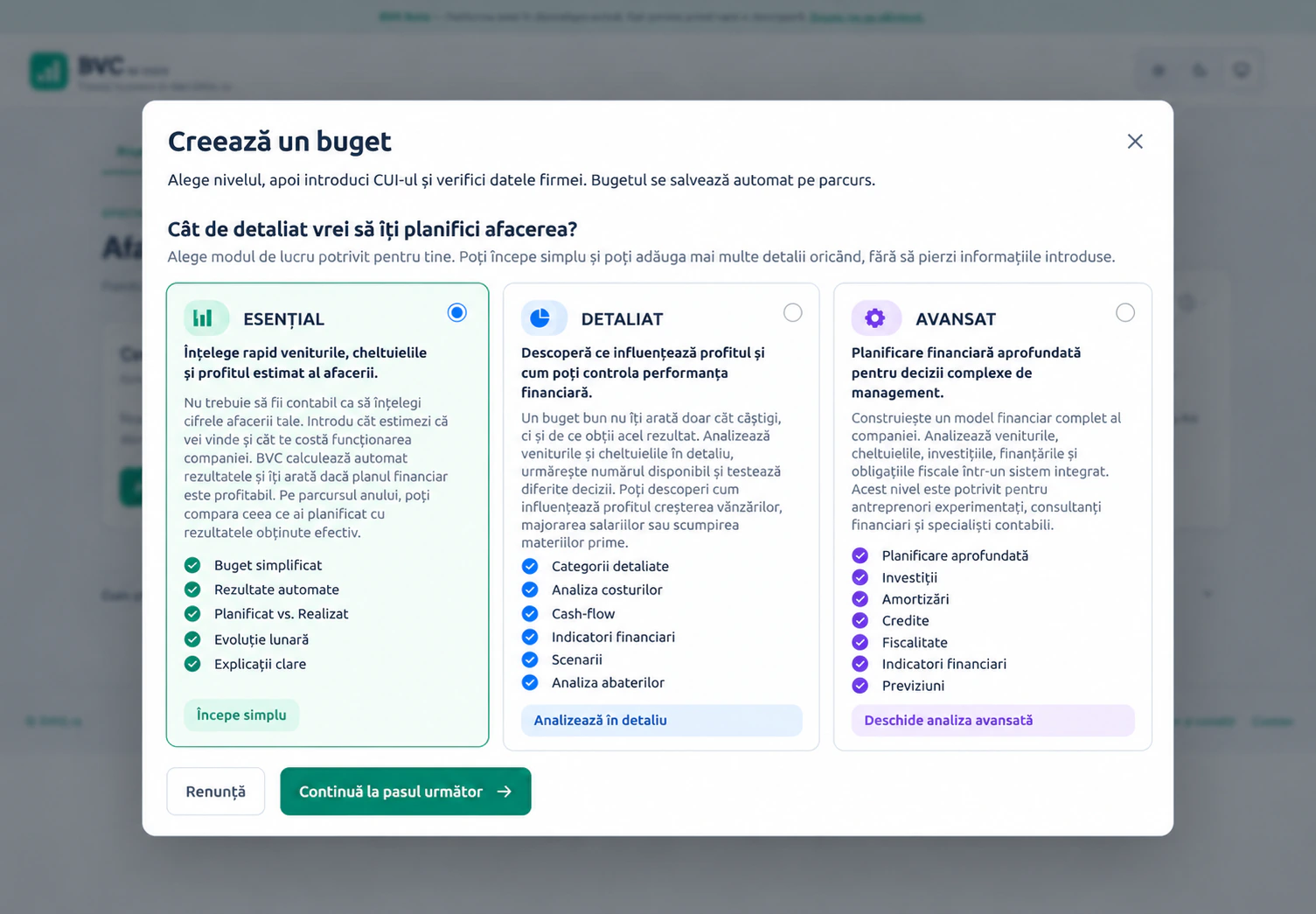
The "Create a budget" window in BVC by SIXIS, with three levels of work: Basic, Detailed and Advanced, each with a list of included functions.
Illustrative example You choose how detailed you want to plan: Essential, Detailed or Advanced. You can start simple and add details later without losing what you entered.
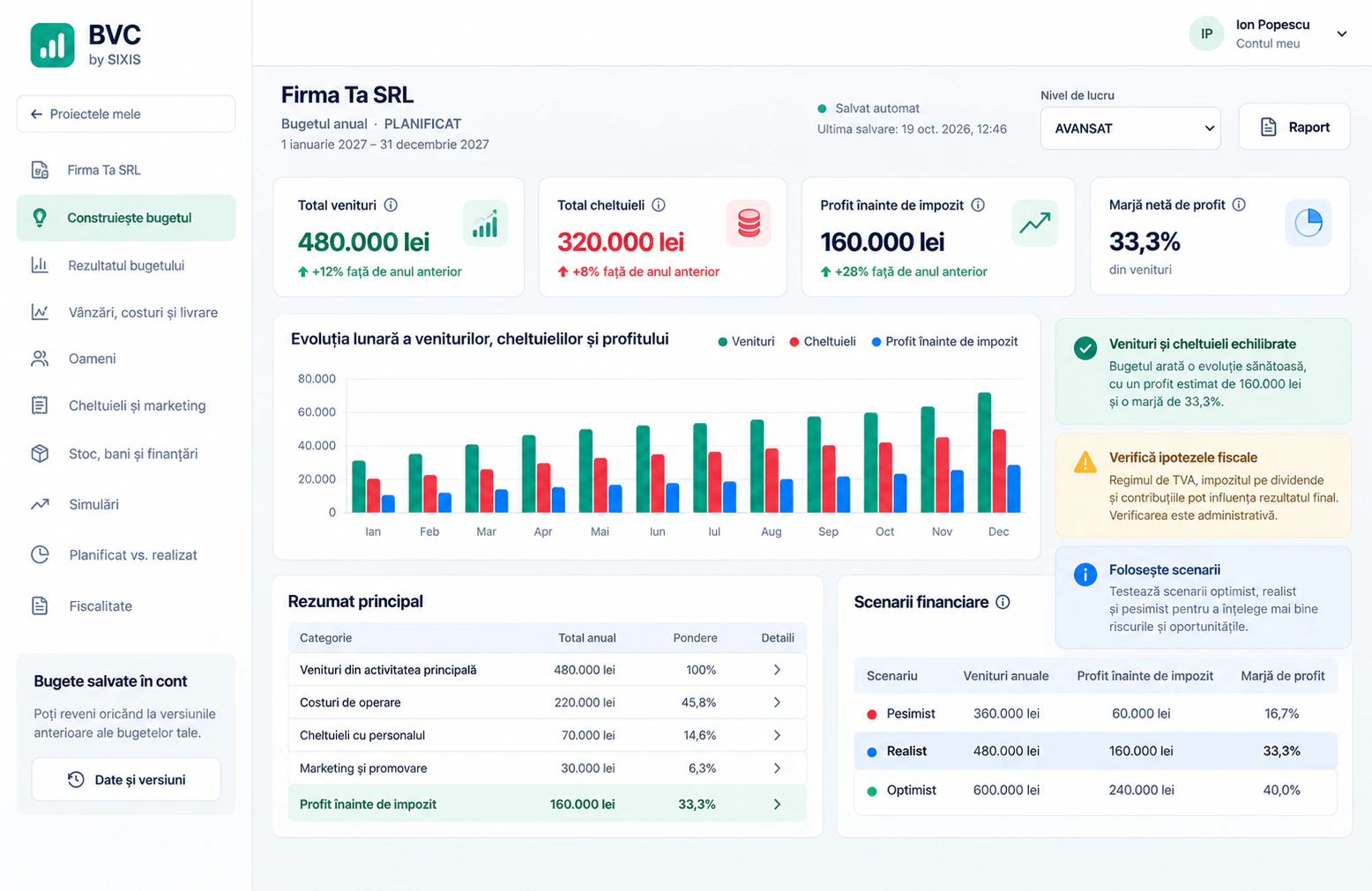
The annual budget of a fictitious company in BVC by SIXIS: total revenues, total expenses, profit before tax, monthly evolution, summary by category and financial scenarios.
Illustrative example The budget of a fictitious company, in the Advanced level: totals, monthly evolution, summary by category and the pessimistic, realistic and optimistic scenarios.
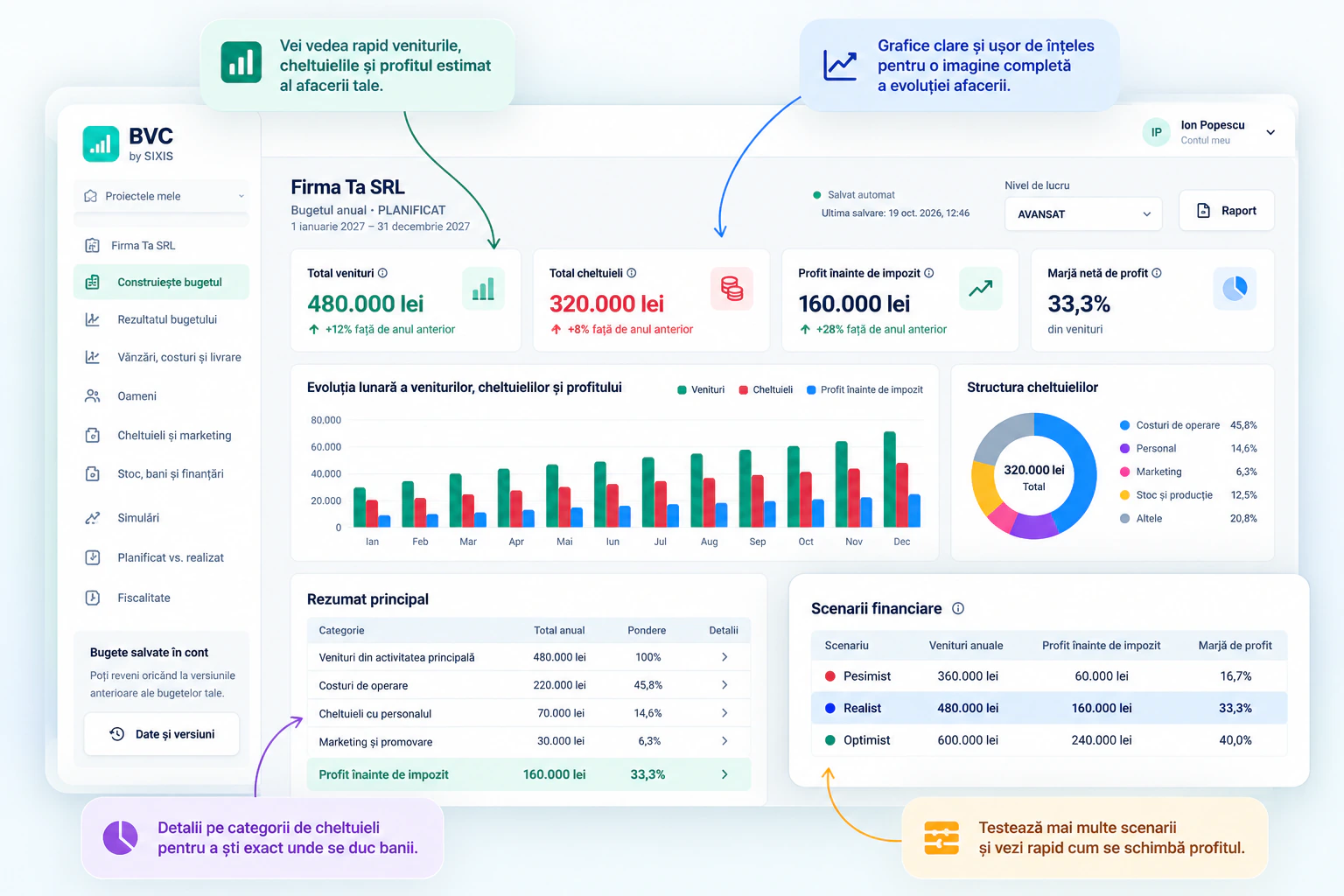
The same BVC by SIXIS interface, with explanations in the margins about totals, graphs, expenditure structure and financial scenarios.
Illustrative example The same interface, with explanations in the margins: where you see revenue and estimated profit, how to read graphs, where the money goes and how to compare scenarios.

04 · What you can do

What you can do with BVC by SIXIS.

BVC by SIXIS is a budgeting and financial simulation web application. Here's what you can do in it:

You build the budget
You start from an existing company, from a simulation or from an example with fictitious figures. Enter the data you have; the rest can wait.
You estimate the income
Add sales sources and monthly estimates. Seasonality is part of the calculation.
You estimate the expenses
Rent, team, marketing, direct costs, logistics. What you don't know yet doesn't count as zero: the app shows you what you're missing.
Analyze profitability
See the estimated profit, the level of sales required to cover your operating costs and what influences it.
Analyze cash
Receipts, payments, terms and stock explain the difference between profit and money in the account.
Simulate scenarios
Higher sales, higher costs, a change in activity. Saved scenarios do not change the base budget.
Compare planned with realized
Enter the actual results monthly and compare them with the plan. The plan remains intact.
You follow financial indicators
Indicators linking sales, costs, profit and cash, where the chosen level includes them.
You choose how detailed you want
Three levels of detail: Basic, Detailed, Advanced. You can start simple and add details later with the same data.

Three levels, same budget

  • EssentialSimplified budget, automatic results, planned versus realized, monthly evolution. For those who are not accountants and want to quickly understand if the plan is working.
  • DetailedDetailed categories, cost analysis, cash-flow, indicators, scenarios and deviation analysis. For those who want to know why they get a result.
  • AdvancedInvestments, depreciation, credits, taxation and forecasting in an integrated model. Suitable for experienced entrepreneurs and specialists.

BVC is a planning tool. It does not take the place of bookkeeping, does not replace an accountant and does not provide personalized financial advice. Where tax estimates appear, they are indicative and are separately verified.

05 · How it works

Three steps, no meetings.

  1. Enter the estimates

    You choose whether to start from an existing company (with CUI), from a simulation or from an example, then the level of detail. Add what you sell and what you spend, with estimates, not certainties.

  2. You build and analyze the budget

    The application calculates the results as you fill in: estimated profit, monthly evolution, cash. See immediately what's missing and what's connected to what.

  3. Compare scenarios and understand the results

    You test realistic, optimistic and pessimistic options and, during the year, you put next to the plan what actually happened.

06 · An example

The same figures, three scenarios.

Demo representation, with hypothetical values, not a capture from the application and not the data of a company. The activity has fixed costs of 26,000 RON per month and a margin of 35% in the basic assumption. In a single year, in the realistic scenario, the first three months are in the red, although the year ends with a profit.

One year of activity in three scenarios · annual totals in RON, before tax
HypothesisRevenueProfit
Pessimisticsales −15%, margin −3 points989.4004.608
Realisticbasic assumption1.164.00095.400
Optimisticsales +15%1.338.600156.510

The difference between the best and the weakest version is great, and the weakest still remains on the plus side. Just the kind of thing you find out from a budget and not intuition. See the same figures, in the BVC scene on the first page of SIXIS.

07 · Questions

Questions about the revenue and expense budget.

What is a revenue and expense budget?

It is the financial plan of a business. You write down how much you expect to sell, how much it will cost you to operate, and how much money should be left over. You don't have to be an accountant to do this. You just have to start asking the right questions.

How do I build a BVC for a company?

You start with what you know. How much you sell, how much it costs you for goods, rent, salaries and other expenses. You don't have to have all the answers from day one. In BVC you choose the level of detail, enter the estimates and see the results. As you learn more, you complete the budget.

Why does a company need a BVC?

Because a business can be doing well today and have problems three months from now. Maybe you want to hire people, open a workplace or invest in equipment. The question isn't just how much it costs, but whether you can afford it and what happens if sales don't turn out as you predicted.

What is the difference between profit and cash-flow?

You can have a profitable business and at the same time not have money to pay the salaries. Does that sound absurd? Not really. You invoiced 100,000 RON, but the customers pay you over 60 days. Meanwhile, salaries, rent and suppliers do not wait. Profit tells you if the business is making money. The cash flow shows you when money actually comes in and goes out.

Can I simulate a business before establishing it?

Yes. And you'd better do the math before you sign that first lease. You can estimate sales, costs, the people you need and the initial investment. You won't know for sure if the idea will work, but you will understand what needs to happen for it to be profitable.

Can I build a budget for a project?

Yes. Not every budget has to be about the whole company. Maybe you want to launch a product, open a store or start a new project. You can analyze revenue, costs and estimated profit separately, without mixing all the business figures.

Can I budget a separate department?

Yes. For example, you want to know how much the sales department costs and what results it should produce. You can build a separate budget for it. Important: the department budget does not replace the company budget, and taxes and dividends are not calculated independently for each department.

What do realistic, optimistic and pessimistic scenarios mean?

Suppose you estimate sales of 100,000 RON per month. But what if you sell 15% less? But what if you sell 15% more? Scenarios allow you to see how the outcome changes in each situation. They are not predictions. There are options that are worth checking out before making a decision.

How do I compare the planned budget with the actual results?

You estimated sales of 60,000 RON in January, but you achieved 52,000. The difference is 8,000 RON. It is not enough to notice it. You have to understand where it's coming from. In BVC you can enter the actual results and compare them with the initial estimates, without changing the plan.

What levels of detail does BVC by SIXIS offer?

Three: Essential, Detailed and Advanced. If you just want to understand your income, expenses and bottom line, you start with Essentials. If you need cost analysis, cash and scenarios, choose Detailed. For investments, loans, depreciation and taxation, there is Advanced. You don't have to start with the most complicated one.

Is BVC by SIXIS free?

Yes. The app is free and can be used by anyone. You don't have to be a SIXIS client and you don't have to contract consulting services.

Do I need advanced financial knowledge?

No. If you know how much you expect to sell and what your expenses are, you can get started. The app helps you organize the numbers and understand the results. For complex tax or accounting situations, however, verify the information with a specialist.

Work out the numbers before you commit.

Start with what you know. You can fill in the rest along the way.

Build your budget ↗App available in Romanian

BVC by SIXIS is a tool created by SIXIS, Business Operations company. The application is separate from SIXIS commercial services.